Moving from Pakistan to Canada — The Complete 2025 Guide for Families, Professionals & Students
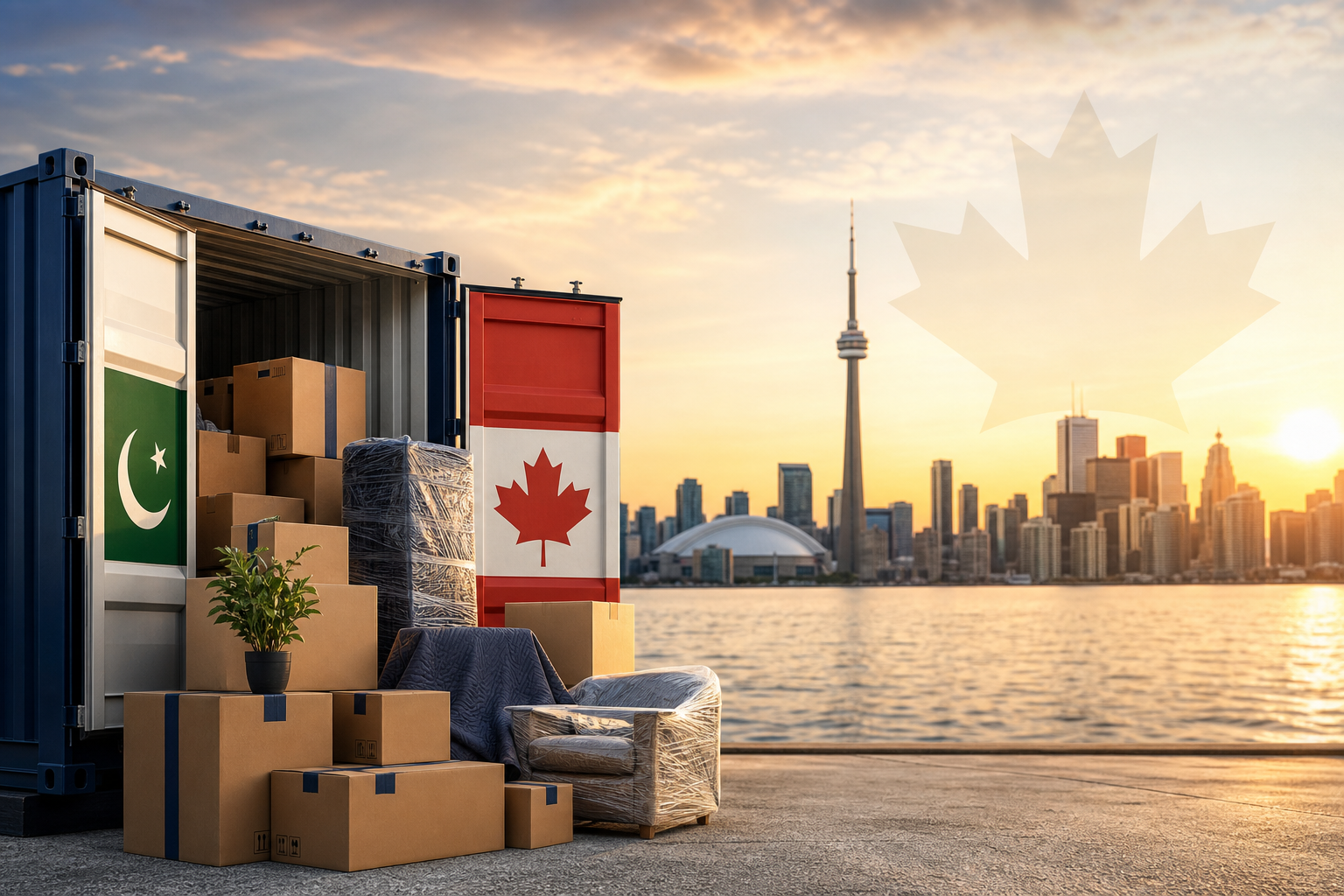
By Best Int'l Movers · Updated: June 2025 · Reading Time: 12 Minutes
Moving from Pakistan to Canada is one of the most exciting — and most complex — decisions you will ever make. Canada is consistently ranked among the world's best countries for quality of life: world-class healthcare, excellent education, a strong economy, a welcoming multicultural society, and one of the largest and most established Pakistani communities outside Pakistan itself.
But between the excitement of your Canadian future and the reality of getting there lies a mountain of planning — visas, paperwork, shipping your belongings, customs regulations, finding a home, and getting settled. This comprehensive guide walks you through every step of the process, from your very first decision to your first month living in Canada as a new resident.
Whether you are moving under Express Entry, a Provincial Nominee Program, a family sponsorship, or a student visa, this guide covers everything you need to know. Let us begin.
Step 1: Choosing the Right Canadian Visa Pathway
Canada offers multiple immigration pathways for Pakistani nationals. Understanding which route applies to you is the essential first step — and it also determines your timeline for planning your move.
Express Entry — Fastest Route for Skilled Workers
Express Entry is Canada's primary system for skilled worker immigration. It covers three federal programs:
- Federal Skilled Worker Program (FSWP): For professionals with work experience in eligible NOC occupations
- Canadian Experience Class (CEC): For people already in Canada on work or study permits
- Federal Skilled Trades Program (FSTP): For qualified tradespeople
Candidates are ranked by a Comprehensive Ranking System (CRS) score based on age, education, language (IELTS), and work experience. In recent years, Pakistani engineers, IT professionals, healthcare workers, and accountants have received ITAs with CRS scores in the 470–520 range.
Provincial Nominee Programs (PNPs)
All Canadian provinces and territories (except Quebec) run Provincial Nominee Programs. Popular PNPs for Pakistanis include:
- Ontario Immigrant Nominee Program (OINP) — Human Capital Priorities stream
- British Columbia PNP (BC PNP) — Tech Pilot for IT professionals
- Alberta Advantage Immigration Program (AAIP)
- Manitoba Provincial Nominee Program (MPNP)
- Saskatchewan Immigrant Nominee Program (SINP)
A provincial nomination adds 600 CRS points to your Express Entry profile — virtually guaranteeing an ITA.
Family Sponsorship
If you have a Canadian citizen or permanent resident spouse, parent, or child who can sponsor you, family sponsorship is often the fastest pathway. Spouses can apply for an open work permit while their PR application is processed.
Student Visa — Study Permit
Canada is among the world's top study destinations. A Canadian study permit allows you to work part-time (20 hours per week) during studies and full-time during scheduled breaks. Many students transition to permanent residency through the Post-Graduate Work Permit (PGWP) and Canadian Experience Class after graduation.
Super Visa — For Parents & Grandparents
Canadian citizens and permanent residents can invite their parents and grandparents on a Super Visa — valid for up to 10 years allowing stays of up to 5 years at a time.
| Visa Type | Typical Processing Time (2025) |
|---|---|
| Express Entry (ITA to PR) | 6–8 months from ITA |
| Provincial Nominee Program | 12–18 months total |
| Spouse Sponsorship | 12–14 months |
| Student Visa (Study Permit) | 4–8 weeks |
| Super Visa (Parents) | 8–12 weeks |
| Visitor Visa | 2–4 weeks |
Step 2: Understanding the Pakistani Community in Canada
With over 300,000 Pakistanis across Canada, you will find familiar food, languages, mosques, cultural events, and community networks wherever you settle.
| City / Area | Pakistani Community Notes |
|---|---|
| Toronto (Mississauga, Brampton) | Largest Pakistani community in Canada. 'Little Pakistan' areas in Mississauga and Brampton. |
| Vancouver (Surrey, Burnaby) | Growing South Asian community. Strong Punjabi-speaking population. |
| Calgary | Fast-growing Pakistani community driven by oil sector jobs. |
| Edmonton | Significant Pakistani population with multiple mosques and halal markets. |
| Ottawa | Smaller but well-established community near government sector jobs. |
| Montreal | French-language requirement. Smaller Pakistani community but growing. |
| Winnipeg | MPNP actively recruits internationally. Pakistani community expanding. |
Step 3: Planning Your Move — What to Bring and What to Leave Behind
One of the most important — and most underestimated — parts of any international move is deciding what to ship, what to sell, and what to leave behind.
What to Definitely Bring
- All important documents — passports, educational certificates, degree attestations, marriage certificate, children's birth certificates, IELTS results, employment letters
- Clothing — especially Pakistani traditional wear; winter clothes are expensive in Canada
- Medicines and prescriptions — bring 3–6 months supply
- Electronics — Pakistani appliances use 220V; Canada uses 120V. You will need voltage converters
- Jewellery — declare all jewellery at Canadian customs accurately
- Sentimental items — family heirlooms, photo albums
- Pakistani specialty foods — spices, dried goods
- Children's toys, books, and comfort items
- Prayer mats, Qurans, and Islamic items
What to Consider Carefully
- Furniture — Shipping via sea freight is affordable. Canadian furniture is expensive.
- Large appliances — Check voltage and plug compatibility before shipping
- Car — Possible but involves import duty. Research Canadian import requirements carefully
- Pakistani TV units and satellite dishes — May not work in Canada without modification
What to Leave or Sell
- Old or cheap furniture — not worth the shipping cost
- Items easily available at low cost in Canada (IKEA, Costco, Facebook Marketplace)
- Bulky appliances with incompatible voltage
- Items with no sentimental value taking up container space
Step 4: Shipping Your Belongings from Pakistan to Canada
Shipping your household goods and personal belongings from Pakistan to Canada requires careful planning around timing, shipping method, and cost.
| Shipping Method | Details |
|---|---|
| Sea Freight FCL (Full Container) | Entire 20ft or 40ft container exclusively yours. Best for full household moves. Transit: 30–40 days port to port. |
| Sea Freight LCL (Shared Container) | Pay per cubic meter (CBM). Best for partial loads. Transit: 35–50 days door to door. |
| Air Freight | 5–9 business days. Much more expensive per kg. Best for urgent essentials only. |
| Courier / Express Parcel | Best for documents, small packages under 5 kg. DHL, FedEx, TNT options. |
Pakistan to Canada — Sea Freight Transit Times
| Route | Port to Port | Door to Door (Est.) |
|---|---|---|
| Karachi → Vancouver (YVR) | 22–28 Days | 32–42 Days |
| Karachi → Toronto (via Halifax) | 28–35 Days | 40–50 Days |
| Karachi → Montreal (PAKMT) | 28–35 Days | 40–50 Days |
| Karachi → Calgary (via Vancouver) | 25–32 Days | 36–46 Days |
What Documents Do You Need to Ship to Canada?
- Passport copy of shipper and receiver
- Packing list — detailed inventory of all items with values
- Bill of Lading (B/L) — issued by shipping company
- CBSA Form B4 — Personal Effects Accounting Document for settler's effects duty-free entry
- CBSA Form B4A — Goods Accompanying / To Follow list
- Proof of Canadian PR or visa status
- Proof of previous Pakistan residence (utility bills, tenancy agreement)
Our team prepares all shipping documentation and guides you through the CBSA B4 / B4A process — the most important step for importing your belongings duty-free as a new Canadian immigrant.
Step 5: Canadian Customs — Importing Your Belongings Duty-Free
This is the section most people get wrong — and it is the most financially important. Canada Border Services Agency (CBSA) has a specific process for new immigrants importing personal effects. Done correctly, you pay zero duty and zero tax.
Settler's Effects — The Duty-Free Import Rule
As a new Canadian permanent resident or returning Canadian citizen, you are entitled to import your personal and household effects duty-free and tax-free under Canada's Settler's Effects provision.
- You must be admissible to Canada as a permanent resident or citizen
- Goods must have been owned and used by you for at least 6 months before the move
- Goods intended for personal use — not for resale or commercial purposes
- File CBSA Form B4 (Goods Accompanying You) and B4A (Goods to Follow) at your port of entry
- All duty-free goods must be listed on the B4/B4A — unlisted goods lose their exemption
- Goods in transit must arrive in Canada within 12 months of your arrival date
What is NOT Exempt from Canadian Customs Duty
- Alcohol and tobacco products — subject to duty and excise taxes
- Vehicles — subject to 6.1% duty plus 5% GST
- Goods purchased after you left Pakistan
- Commercial goods or goods intended for resale
- Gifts for Canadian residents (over CAD 60 value)
Canadian Prohibited & Restricted Items
- Firearms and weapons — require special permits and RCMP registration
- Narcotics and controlled substances — strictly prohibited
- Fresh fruits, vegetables, and plants — may be seized by CBSA biosecurity
- Certain meats and dairy products without proper certification
- Counterfeit goods — seized and destroyed
- Currency over CAD 10,000 — must be declared
- Endangered species products — CITES convention applies
Step 6: Cost of Living in Canada — What Pakistani Families Should Expect
Canada offers an excellent quality of life, but proper financial planning before your move is essential.
| Expense | Monthly Cost (CAD) — Family of 4 |
|---|---|
| Rent — 3 bedroom apartment (Toronto) | CAD 2,800 – 3,800 |
| Rent — 3 bedroom apartment (Calgary) | CAD 2,000 – 2,800 |
| Groceries (including halal food) | CAD 800 – 1,200 |
| Utilities (electricity, heat, water) | CAD 150 – 250 |
| Internet & Mobile Phones (x2) | CAD 150 – 220 |
| Transportation (car or transit) | CAD 200 – 500 |
| Children's school (public — free) | CAD 0 |
| Health Insurance (before provincial coverage) | CAD 200 – 500 |
| Total Estimated Monthly | CAD 4,300 – 6,500 |
Canadian Salaries — What Pakistanis Can Expect
| Profession | Average Annual Salary (CAD) |
|---|---|
| Software Engineer / IT Professional | CAD 80,000 – 130,000 |
| Registered Nurse | CAD 70,000 – 90,000 |
| Civil / Structural Engineer | CAD 65,000 – 95,000 |
| Accountant (CPA) | CAD 60,000 – 90,000 |
| Medical Doctor (after licensing) | CAD 200,000 – 350,000 |
| Teacher (licensed) | CAD 55,000 – 80,000 |
| Truck Driver | CAD 55,000 – 75,000 |
| Construction Trades | CAD 50,000 – 80,000 |
Step 7: Finding a Home in Canada Before You Arrive
Housing is the biggest challenge facing new Pakistani immigrants to Canada. The Canadian rental market — especially in Toronto and Vancouver — is extremely competitive.
Before You Arrive — Remote Search
- Use Realtor.ca, Zumper, Kijiji, and Facebook Marketplace for rental listings
- Join Pakistani community groups for your target city
- Many landlords accept applications with first and last month's deposit from new immigrants
- Consider furnished short-term rentals (Airbnb) for your first 2–4 weeks
- Some Pakistani families rent a room with another family initially to save costs
Best Cities for Pakistani Families — Our Assessment
| City | Best For | Challenge |
|---|---|---|
| Mississauga/Brampton (ON) | Largest Pakistani community, halal food everywhere | Very high rent |
| Calgary (AB) | Lower cost of living, growing economy, good jobs | Harsh winters |
| Edmonton (AB) | Affordable, oil sector jobs, expanding community | Cold winters |
| Winnipeg (MB) | MPNP immigration easier, affordable housing | Extreme cold |
| Surrey (BC) | Large South Asian community, mild weather | High rent |
| Ottawa (ON) | Government jobs, bilingual advantage, family-friendly | Moderate rent |
Step 8: Essential First Steps After Arriving in Canada
Your first two weeks in Canada are critical. Here is a prioritised checklist:
- Get your Permanent Resident (PR) card — applied for automatically, takes 8–10 weeks
- Apply for your Social Insurance Number (SIN) at Service Canada on arrival
- Open a Canadian bank account — TD, RBC, Scotiabank, BMO, CIBC have new immigrant packages
- Get a secured credit card — essential for building Canadian credit history immediately
- Register children in school — contact your local school board with proof of address
- Apply for provincial health coverage — waiting period varies (Ontario/BC: 3 months, Alberta: immediate)
- Get a Canadian SIM card — Rogers, Bell, Telus, or budget options like Freedom, Koodo, Fido
- Get a Canadian driver's licence — Pakistani licence exchange within first 60–90 days (varies by province)
- Register with your provincial settlement agency — free language classes, job search help
- File your taxes — even if you arrive mid-year, new immigrants often receive significant tax benefits
Step 9: Healthcare in Canada — What New Pakistani Immigrants Need to Know
- Provincial health insurance (OHIP, AHCIP, MSP) covers doctor visits, hospital care, and most procedures
- Most provinces have a 3-month waiting period — buy private health insurance for this period
- Dental and vision care: NOT covered by provincial health insurance
- Prescription medicines: Partially covered through employer benefits or provincial drug programs
- Specialists: Require a referral from your family doctor (GP)
- Emergency care: Always covered — no waiting period for emergency treatment
- Mental health: Growing coverage in many provinces
Step 10: Pakistani Community & Cultural Life in Canada
Mosques & Islamic Centres
- Canada has hundreds of mosques across all major cities — Friday Jummah, Eid prayers, and Islamic education all available
- Islamic Society of North America (ISNA) Canada operates major Islamic centres
- Many cities have Islamic schools for children — full-day and weekend options
Halal Food
- Halal meat, Pakistani groceries, and specialty foods available across all major Canadian cities
- Pakistani restaurants abundant in Toronto, Calgary, Edmonton, and Vancouver
- Major grocery chains carry halal meat in high South Asian density areas
- Pakistani brands like National, Shan, Shezan available in most South Asian grocery stores
Pakistani Cultural Organisations
- Pakistan Canada Association (multiple cities)
- Pakistan Consulate General in Toronto, Ottawa, and Vancouver
- Pakistani community events — Eid Milan parties, Independence Day celebrations
- Cricket clubs and Pakistani community sports leagues in Toronto, Calgary, and Vancouver
Complete Moving Checklist — Pakistan to Canada
6–12 Months Before Moving
- Confirm Canadian visa / PR approval
- Research target Canadian city — compare cost of living, job market, community
- Start decluttering — decide what to ship, sell, and leave
- Get all documents attested — educational certificates, marriage certificate, birth certificates
- Get IELTS results (if not already done)
- Research Canadian credential recognition for your profession
- Start saving — target CAD 20,000+ in savings for first months
3–6 Months Before Moving
- Book your shipping company — get home survey and quote
- Contact CBSA regarding B4/B4A forms for settler's effects
- Book flights — early booking for significant savings
- Arrange temporary accommodation in Canada (Airbnb, family, friend)
- Research Canadian schools for children — school year starts September
- Get medical check-ups and stock up on prescription medicines
- Start Canadian job search — LinkedIn, Indeed.ca, Workopolis
1–3 Months Before Moving
- Professional packing and loading of household goods
- Cancel Pakistani utilities, subscriptions, and memberships
- Notify bank — get international debit card and sufficient foreign currency
- Transfer money to Canada — use Wise or similar for best exchange rates
- Get vehicle documents if shipping car
- Pack personal carry-on bag: documents, medicines, valuables, children's essentials
Arrival Week in Canada
- File B4 form at port of entry — declare all goods
- Apply for SIN at Service Canada
- Open Canadian bank account
- Get Canadian SIM card
- Apply for provincial health card
- Register children in school
- Get secured credit card — start building credit
Frequently Asked Questions — Moving from Pakistan to Canada
How much money do I need to move from Pakistan to Canada?
IRCC requires proof of settlement funds — approximately CAD 13,000 for a single person, CAD 16,000 for a couple, and CAD 20,000–25,000 for a family of four. Beyond the IRCC requirement, we recommend bringing CAD 20,000–30,000 to comfortably cover first and last month's rent, furniture, car, and living expenses for the first 3–6 months before your income stabilises.
How long does it take to get Canadian PR from Pakistan?
Under Express Entry, the process typically takes 6–8 months from Invitation to Apply (ITA) to PR approval. Provincial Nominee Programs take 12–18 months in total. Family sponsorship takes 12–14 months. Start planning your move logistics 3–4 months before your expected PR confirmation.
Can I bring my Pakistani car to Canada?
Yes, but it involves import duty (6.1% of vehicle value) plus 5% GST, plus compliance modification costs if the vehicle does not meet Canadian safety and emissions standards. For most Pakistani vehicles, it is more economical to sell in Pakistan and buy in Canada.
Is IELTS mandatory for Canadian immigration?
For Express Entry and most PNPs, yes — IELTS General Training is required. A minimum CLB 7 (IELTS 6.0 in all bands) is needed for FSWP, but higher scores (CLB 9 = IELTS 7.0–7.5) add significant CRS points.
What is the best province in Canada for Pakistani immigrants?
Ontario (Mississauga and Brampton) has the largest established Pakistani community and best cultural infrastructure. Alberta (Calgary and Edmonton) offers lower cost of living. British Columbia has a large South Asian community but very high housing costs. Your best province depends on your profession, family situation, and budget.
How do I ship my household goods from Pakistan to Canada?
The most cost-effective method for a full household is sea freight FCL (Full Container Load). For partial loads, LCL groupage shipping is ideal. Contact Best Int'l Movers for a free home survey and all-inclusive quote covering packing, export customs, sea freight, Canadian CBSA clearance, and door delivery anywhere in Canada.
Final Thoughts — Your Pakistan to Canada Move Starts Here
Moving from Pakistan to Canada is a journey that millions of Pakistanis have successfully made before you. Canada is a country that genuinely welcomes immigrants and gives them the tools to build successful, fulfilling lives. With proper planning, the right professional support, and a realistic understanding of what to expect, your move can be one of the best decisions of your life.
At Best Int'l Movers, we have helped thousands of Pakistani families and professionals make this exact move. We know the Pakistan-Canada shipping route inside out — from the export customs procedures at Karachi Port to the CBSA B4 forms at Toronto Pearson. Our team is here to handle the logistics so you can focus on the excitement of your new Canadian chapter.
Good luck with your move. Canada is waiting for you — and so are we.
Need a shipping plan?
Get a free quotes from Best International Movers & Logistics — 0300-9130211 · info@bestintlmovers.com
Get Free Quote